

Protein maxing does nothing for your gains.
During the age of carnivore diets, many of us believe that eating a shit ton of protein is essential for growth, but like everything in life, there is a healthy balance. The general rule heard frequently in the interest of building muscle is, "You should eat a gram of protein per body weight minimum, but more is fine." So is this true?
According to the 2020-2025 Dietary Guidelines for Americans, an adult aged 19 through 30, consuming 2200 calories per day, should consume 6 ounces of protein daily. Only two-thirds of that should be made up of meats, poultry, and eggs. 6 ounces of protein is 168 grams or 672 calories, which is about 30% of your diet.
Assuming you are eating in a surplus of 2,800 calories, your daily consumption would be 7 ounces or about 784 calories worth of protein.
Why is this important?
The human body can not store excess protein once its needs are met. Excess protein consumption will lead to protein oxidation; making the consumed protein less beneficial and a negative to overall health. Excess protein will simply be stored a minimal energy and fat.
Is there a danger of excess protein consumption?
Performance is important, but what good is performance if you can't function in the first place? Bilsborough and Mann suggested the maximum intake is around 2g to 2.5g per kg of body weight per day or 0.9 to 1.13 grams per pound of body weight. Protein consumption that exceeds >35% of the daily intake creates a risk for over-consumption which can cause "hyperaminoacidemia, hyperammonemia, hyperinsulinemia nausea, diarrhea, and even death (the "rabbit starvation syndrome")"
While the upper limit of protein intake is not a "one size fits all" model, the Institute of Medicine states "an acceptable macronutrient distribution range for protein intake at 10% to 35% of total energy for adults." Levels of recommended protein intake can vary drastically from person to person based on a variety of factors.
How does excess protein affect performance?
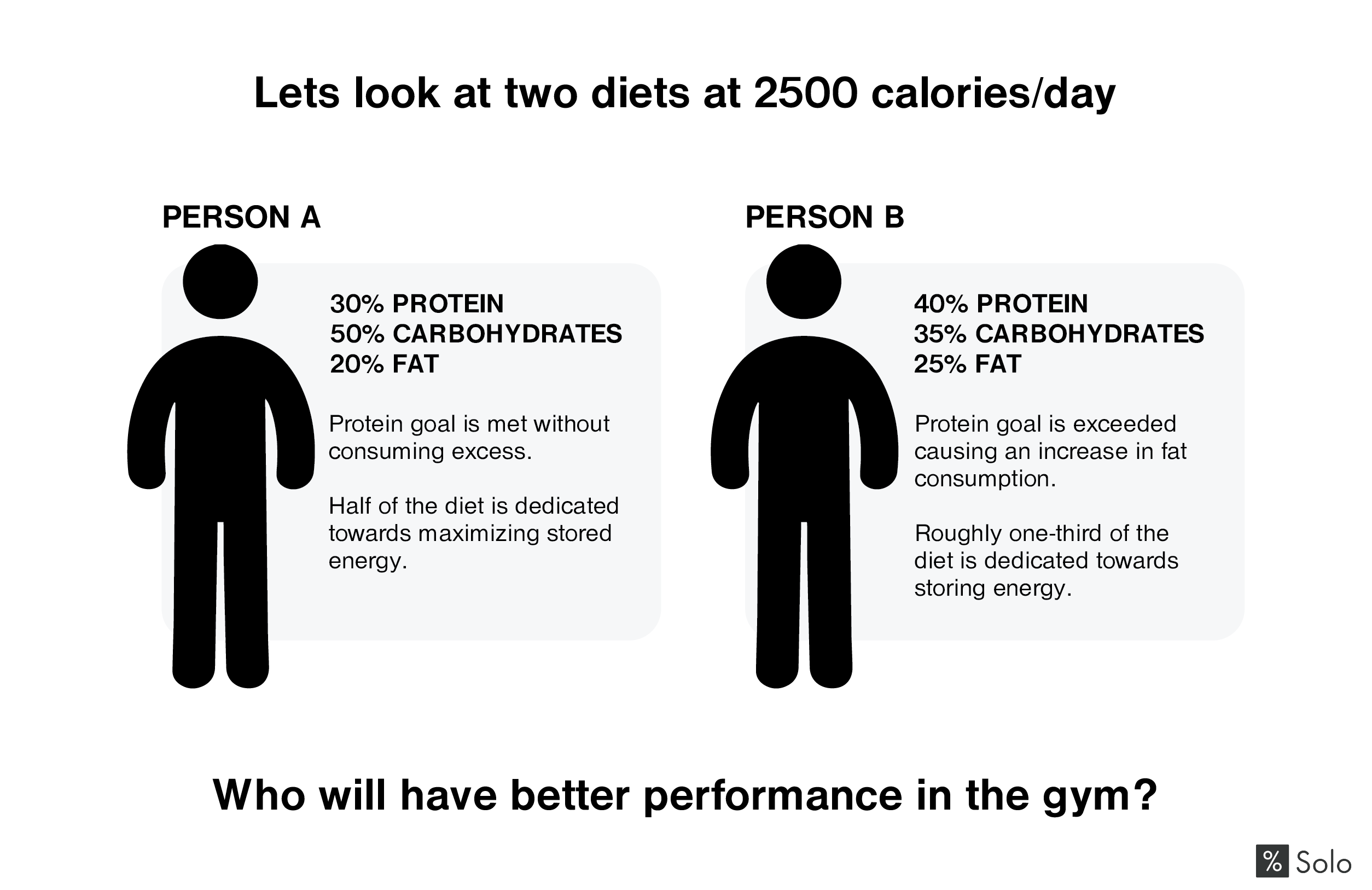
Carbohydrates provide glucose that the body requires for energy. According to Oklahoma State University Extension, "About half of the energy used by muscles and other body tissues is from glucose and glycogen, a form of carbohydrate." Once your body has received an adequate amount of protein, the excess provides little benefit to muscle gain. The 2020-2025 Dietary Guidelines for Americans, states that carbohydrates should make up 45-65% of a person's daily calories. By sacrificing carbohydrates for protein, you are sacrificing valuable energy that can be utilized in training.
Less protein can mean more gains!
There is a well-researched article by Menno Henselmans, that showcases studies on optimal protein consumption. In this article, he highlighted many studies that indicated that there is little benefit to protein consumption that exceeds around 0.75g per lb of body weight.
Henselmans highlighted the study by Lemon et al. (1992, which concluded that 0.75g/lb was the highest intake in which body composition benefits occurred. The subject of this study was bodybuilders training 6 days per week.
Eat a balanced diet.
To ensure your diet is balanced for optimal potential, we highly recommend that you track your calories. Regardless of your goal, whether you're losing body fat or trying to gain muscle, tracking your calories will give an essential insight into how you can optimize your diet for your goal.
Simply put: More protein doesn't mean more gains. Excess protein can create health complications and can result in a lack of energy, which will hinder performance in training. A balanced diet will be more beneficial for overall health, longevity, performance, and gains in the gym.
Conclusion
Research suggests that protein consumption exceeding 0.75 to 0.91 grams per lb of body weight provides little benefit. It is more optimal to consume around 0.75 grams per lb of body weight and consume a diet with more carbohydrates.